 English
 العربية

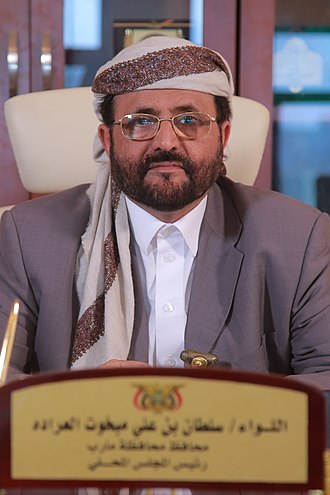
Written by: Sheikh Abdullah Mohammed Qassem Dabwan
Full Name and Birth:
Sultan Bin Ali Mabkhout Al-Aradah was born on January 1, 1958, in Al-Wadi District, Marib Governorate, Yemen. He belongs to the Al-Fjeeh tribe, one of the largest and most influential subtribes of the Abidah tribe in Marib.
Education and Early Political Career:
He graduated from the Faculty of Arts at Sana’a University and began his political and social career in the late 1970s, a time of national transformation and reform.
During this period, he was a founding member of the "Correction Committee" led by President Ibrahim Al-Hamdi. The committee aimed to implement political and administrative reforms as part of a broader state-building vision.
Positions and Responsibilities:
-
Member of the Shura Council from 1987 to 1990.
-
Member of Parliament for two consecutive terms (1993–2003) representing the General People’s Congress (GPC), nominated by consensus among leading political parties.
-
On April 6, 2012, he was appointed Governor of Marib, initiating a new phase of governance and development in the governorate.
-
On April 7, 2022, he was appointed as a Member of the Presidential Leadership Council, the body that assumed the duties of the President and Vice President of Yemen.
Role in the Yemeni War:
Since late 2014, Marib has been under threat by Houthi militias. Major General Al-Aradah played a pivotal role in:
-
Unifying local forces: He successfully brought together various political, tribal, and religious factions to confront the common threat.
-
Protecting state institutions: He strengthened military and security structures and effectively managed local disputes to prevent internal collapse.
-
Establishing a strong coordination network among military and civil authorities to maintain services and governance under difficult conditions.
Popular Reputation and Balanced Leadership:
Major General Al-Aradah is widely respected across tribal and official circles. He is known for:
-
Peacefully resolving tribal and political disputes, gaining the trust and respect of citizens across Marib.
-
A leadership style that balances tribal influence and state authority, especially in a region where both dynamics are essential.
-
Support for freedom of expression and the press, viewing media as a cornerstone for public awareness and community development.
In the Presidential Leadership Council:
Since joining the Presidential Leadership Council in 2022, he has contributed to:
-
Security and military arrangements not only in Marib but also in other key governorates.
-
Strategic national decision-making, with a clear focus on unity and sovereignty.
-
Active engagement in critical files, leveraging his military experience and deep-rooted tribal connections.
Field Initiatives and Activities:
-
Regular participation in security and executive meetings in Marib to ensure coordination between military and civil entities.
-
Key initiatives, such as working to reopen the vital Al-Bayda–Marib road, helping to improve economic and civilian movement.
-
Ongoing support for development and infrastructure projects, despite the challenges posed by the ongoing conflict.
Media Presence and Public Communication:
Major General Al-Aradah maintains strong public engagement through:
-
Field visits and official delegations, including a recent return from Saudi Arabia in March 2025 after official meetings.
-
Active use of social media (such as Facebook and Twitter), keeping the public informed and fostering transparency.
Conclusion – The Essence of Major General Sultan Al-Aradah:
Major General Al-Aradah exemplifies modern Yemeni leadership, characterized by:
-
Astute political judgment, grounded in legislative experience and social awareness.
-
Influential military presence in resisting Houthi advances and securing key territories.
-
A unique ability to integrate tribal traditions with institutional governance.
-
A symbol of stability and civil-military cohesion, especially in the strategic governorate of Marib.
By all measures, Sultan Al-Aradah is not merely a state official—he is a pillar of national resilience and a figure of contemporary Yemeni statecraft.
Add New Comment